

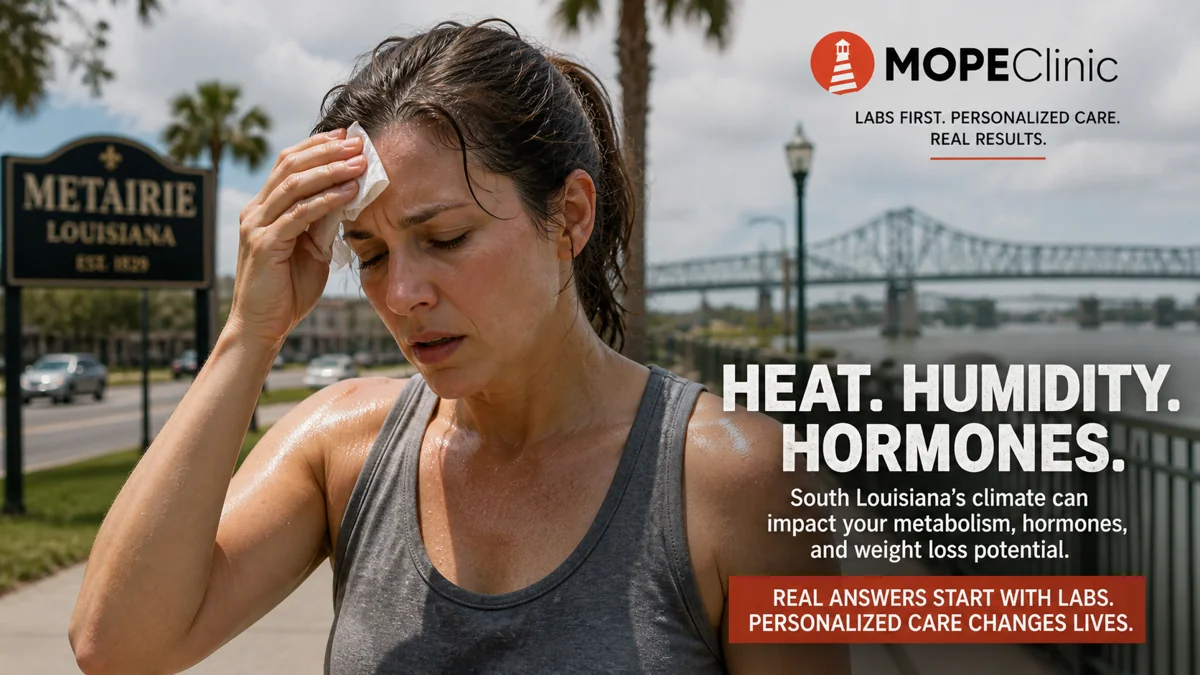
If you’ve lived in South Louisiana for any length of time, you know the heat and humidity aren’t just uncomfortable—they’re relentless. From June through September, the combination of 90-plus-degree temperatures and 80-90% humidity creates a metabolic environment that most standard health advice completely ignores.
Here’s the critical insight most people miss: heat, humidity, hormones, and metabolism are deeply connected. Your body’s hormonal response to heat and humidity directly impacts how quickly you can lose weight, how much energy you have, and whether your testosterone or estrogen levels stay stable. In Metairie, New Orleans, and across South Louisiana, we see a consistent pattern—people working harder to lose weight while their hormones quietly work against them.
Understanding how heat humidity hormones metabolism interact is essential because real metabolic shifts happen when you’re living in a hot, humid climate—and why a personalized hormone evaluation changes everything.
The Problem: How Heat, Humidity, Hormones & Metabolism Disrupt Weight Loss
Why Living in Constant Heat Changes How Your Body Works
Imagine following a solid nutrition plan and moving your body consistently, yet the scale refuses to budge come July. You’re retaining water. Your energy dips at 2 PM. You feel heavier even though you haven’t changed your habits.
Fundamentally, your environment is actively shifting your heat humidity hormones metabolism balance. Your body operates as more than a calorie calculator—it’s an intricate system of hormones responding to external conditions including temperature, humidity, light exposure, and the cardiovascular demands heat places on you.
Consequently, South Louisiana’s climate creates specific metabolic stressors that most people never address because they don’t understand what’s happening biochemically. This is why understanding the relationship between heat humidity hormones metabolism matters so much for weight loss success.
The Metabolic Reality of South Louisiana Heat
When you’re sweating constantly in Louisiana’s oppressive climate, something significant occurs: your core temperature regulation demands enormous amounts of energy. Simultaneously, your electrolyte balance shifts. Your cortisol (stress hormone) stays elevated because heat functions as a form of physical stress on your system.
Particularly concerning is this: if your baseline hormone levels are already suboptimal—whether that involves low testosterone, declining estrogen, or compromised thyroid function—living in oppressive heat amplifies these problems significantly. Meanwhile, people from Metairie to Houma to Slidell consistently report the same experience: “I felt better and lost weight faster when I visited somewhere cool. But here in Louisiana, I plateau.”
They’re not imagining it. Rather, the climate creates measurable, real hormonal shifts. This heat humidity hormones metabolism connection is foundational to understanding why weight loss feels so difficult in the South Louisiana summer.
Why It Happens: The Hormonal Cascade Behind Heat, Humidity, Hormones & Metabolism
Your body has several hormones that regulate metabolism, energy, appetite, and fat storage. When you live in constant heat, multiple hormones shift simultaneously—and if those hormones were already imbalanced, the heat can make everything worse. Understanding these mechanisms is crucial to grasping how heat humidity hormones metabolism dysregulation occurs.
Cortisol and Heat Stress: Your Primary Stress Hormone
Cortisol is your stress hormone, and heat is undeniably a stressor. In South Louisiana’s climate, your body is constantly triggering a low-level stress response just to maintain homeostasis. Elevated cortisol tells your body to hold onto belly fat, increase blood sugar, and suppress immune function. Additionally, it interferes with sleep quality—which, ironically, makes cortisol worse the next day.
For anyone trying to lose weight, chronically elevated cortisol due to heat humidity hormones metabolism dysregulation is essentially sabotage. This is where many standard weight loss approaches fail—they don’t address the hormonal component that makes losing weight so difficult in a hot climate.
Thyroid Function and Temperature Regulation: The Metabolic Engine
Your thyroid controls metabolic rate fundamentally. When your body is working hard to regulate temperature in heat and humidity, thyroid demand increases significantly. If your thyroid is already struggling—either from genetics, autoimmunity, or iodine insufficiency—heat exposure can tip you toward hypothyroidism (low thyroid).
The consequences are real: hypothyroidism slows metabolism, causes water retention, and triggers fatigue. Most people in South Louisiana never get their thyroid tested beyond a basic TSH screening, so the heat humidity hormones metabolism connection goes undiagnosed for years. A comprehensive thyroid panel—not just TSH—reveals whether heat is pushing your thyroid into dysfunction.
Testosterone and Heat: Special Considerations for Men and Women
Men with low testosterone already battle fatigue, low motivation, and difficulty losing weight. Heat makes this considerably worse. Research shows that elevated body temperature can suppress testosterone production temporarily. For men in South Louisiana already running low, the summer months mean even lower T levels, amplifying the problem.
Similarly, women face comparable hormonal challenges where heat can exacerbate imbalances that interfere with estrogen metabolism and fat distribution. This is why many women report easier weight loss during cooler months, and why understanding the heat humidity hormones metabolism connection matters for both sexes.
Sweating, Electrolytes, and Appetite Regulation: The Missing Piece
Constant sweating depletes electrolytes—sodium, potassium, magnesium—which are critical for hormone production, nerve function, and blood sugar regulation. When electrolyte balance shifts, appetite hormones (ghrelin and leptin) become dysregulated.
As a result, you experience hunger at the wrong times. You crave salt and sugar. Your body signals hunger even when it doesn’t need calories. This vicious cycle between heat humidity hormones metabolism imbalance and electrolyte depletion explains why weight loss stalls—and why most generic diet advice fails in South Louisiana’s heat.
Humidity and the Dehydration Trap: The Counterintuitive Problem
This phenomenon is counterintuitive: high humidity can actually make dehydration worse. Why? Because sweat can’t evaporate efficiently, your body keeps working to cool down. You’re losing fluid and electrolytes without the cooling benefit. Your blood becomes slightly more concentrated. Your brain responds by increasing thirst, but also by triggering cortisol release.
Simultaneously, you’re caught in a trap: dehydrated and stressed at the cellular level. For anyone doing medical weight loss (including GLP-1 therapy), this dehydration amplifies side effects and slows fat loss significantly.
Light Exposure and Circadian Rhythm: The Sleep Connection
South Louisiana has intense sun exposure and longer daylight hours in summer. While this sounds beneficial, it can actually disrupt circadian rhythm—especially combined with heat-induced sleep disruption. Poor sleep creates dysregulated growth hormone, cortisol, insulin, and leptin. Everything that controls hunger, energy, and fat loss becomes chaotic when your circadian rhythm breaks down.
Notably, people in South Louisiana often report: “I sleep better when I visit up north. I have more energy. I lose weight faster.”
The climate isn’t just affecting how you feel—it’s affecting your hormonal machinery in measurable ways. This is the core reason why heat humidity hormones metabolism optimization requires climate-aware medical care.
Why Normal Methods Fail: The Gap in Standard Weight Loss & Hormone Advice
Generic Advice Doesn’t Account for South Louisiana’s Realities
Most weight loss and hormone optimization advice comes from national sources—fitness content created in temperate climates, by people who have never experienced genuine, sustained heat stress. Their advice isn’t incorrect, exactly. Rather, it’s incomplete.
The Calorie Deficit Myth: Missing the Hormonal Truth
You’ve heard it countless times: “Calories in, calories out.” This statement is technically true, but it fundamentally misses the hormonal reality. You can maintain a calorie deficit and still struggle to lose weight if your cortisol is elevated, your thyroid is sluggish, your testosterone is low, or your electrolytes are depleted.
In South Louisiana’s heat, these imbalances compound dramatically. You’re fighting your own hormones while also fighting the climate. Without addressing the heat humidity hormones metabolism connection specifically, generic calorie-counting fails because it ignores the biochemical reality of living in oppressive heat.
Hydration Without Electrolytes: An Incomplete Solution
Drinking plain water in the Louisiana heat sounds smart intuitively. However, if you’re sweating constantly, you’re also losing sodium and potassium. Plain water dilutes your blood further, triggering your kidneys to release more fluid. You pee out the water you drank. You stay dehydrated.
Consequently, your hormones stay dysregulated. Standard hydration advice doesn’t acknowledge this critical distinction between plain hydration and the heat humidity hormones metabolism optimization required in South Louisiana’s climate.
One-Size-Fits-All Fitness Programs: The Climate Gap
Running in 95-degree heat with 85% humidity isn’t physiologically the same as running in 75 degrees. Your cardiovascular load is higher. Your cortisol spike is steeper. Your recovery is slower. Yet most fitness apps and programs ignore this environmental reality entirely.
People in South Louisiana follow a “normal” workout plan and either burn out, get injured, or see minimal results. The heat humidity hormones metabolism demands of Louisiana simply aren’t addressed in generic fitness protocols created for nationwide audiences.
Virtual Clinics Miss the Full Picture: No Labs, No Real Care
Here’s the critical flaw with online-only weight loss providers: they can’t order or read your labs. They don’t know whether your thyroid is failing. They don’t measure your testosterone or estrogen. They can’t tell whether your fatigue is hormonal or just “the heat.”
Instead, they offer the same GLP-1 protocol to a 42-year-old man in Metairie as they do to someone in Minnesota—ignoring that the man in Metairie is dealing with cortisol dysregulation from heat stress and potentially low testosterone that’s being suppressed further by summer temperatures. Without understanding heat humidity hormones metabolism individually, you’re not just missing weight loss. You’re potentially taking a medication without understanding whether your baseline hormones are the actual problem.
What Actually Works: Real Solutions for Heat, Humidity, Hormones & Metabolism
Optimizing Metabolism for South Louisiana’s Climate: A Medical Approach
Real weight loss and hormone optimization in South Louisiana requires a different, medically-informed approach. Fundamentally, you need to address the heat humidity hormones metabolism connection directly.
Know Your Baseline: Labs First—Always
Before changing anything, you need comprehensive bloodwork: thyroid panel (TSH, free T4, free T3, thyroid antibodies), testosterone (total and free), estrogen, cortisol, metabolic panel, lipids, and fasting glucose. Why? Because you can’t optimize something you haven’t measured.
Notably, men in South Louisiana often discover they have low testosterone that was never diagnosed because they were only getting a basic annual physical. Similarly, women discover thyroid dysfunction that was dismissed as “just the heat” or “getting older.”
Once you know what’s happening biochemically regarding heat humidity hormones metabolism, everything changes. Your treatment plan becomes personalized instead of generic.
Strategic Electrolyte Management for Heat Stress: Beyond Plain Water
Electrolytes aren’t fancy—they’re sodium, potassium, and magnesium. In South Louisiana’s heat, you need intentional replenishment—not just extra salt, but balanced electrolytes. This stabilizes cortisol, supports thyroid function, regulates appetite hormones, and dramatically improves the effectiveness of any weight loss protocol.
As a result, you’ll notice better energy, better sleep, and faster fat loss. The heat humidity hormones metabolism connection becomes optimized through proper mineral balance. This is why electrolyte supplementation matters more in Louisiana than in cooler climates.
Timing and Intensity Adjustments for Heat: Working Smarter, Not Harder
Working out hard in peak heat (1 PM to 5 PM in South Louisiana) is cortisol escalation. Alternatively, training in early morning (before 9 AM) or evening (after 7 PM) reduces heat stress and cortisol spike.
Consequently, you’ll recover faster, sleep better, and see better results. This isn’t laziness—it’s metabolism science based on how heat humidity hormones metabolism responds to training timing in extreme climates.
Hormone Replacement When Appropriate: Labs-Guided Treatment
If your labs show low testosterone, declining estrogen, or thyroid dysfunction, medication makes sense. But it only makes sense after labs confirm the problem. A man in Metairie with fatigue and weight gain might need testosterone replacement therapy. A woman with similar symptoms might need thyroid support, estrogen optimization, or both.
Generic online clinics guess blindly. Conversely, MOPE Clinic reads your blood and prescribes accordingly based on your individual heat humidity hormones metabolism profile. Here’s what’s often missed: GLP-1 therapy (medical weight loss) works dramatically better when your baseline hormones are optimized first. If you’re running low on testosterone or struggling with thyroid dysfunction, your metabolism is fighting you independently. Address those first. Then GLP-1 can work without battling your own body.
Sleep Optimization in Humidity: Reclaim Your Recovery
Sleep is where hormones rebalance. However, Louisiana’s heat and humidity destroy sleep quality systematically. Real solutions include: cooling technology (fans, AC, moisture control), magnesium supplementation, circadian rhythm alignment (getting morning light exposure, keeping evenings cool and dark), and sometimes addressing underlying sleep apnea (which is more common than people realize and directly impacts hormone levels).
Personalized Nutrition for Climate: More Than Calories
You need different nutrition in 95-degree heat than someone in a temperate climate. Additionally, you need more electrolytes. You might need different meal timing. Your gut health matters more because heat impacts digestion and inflammation.
Yet “personalized” means reading your labs first, understanding your individual heat humidity hormones metabolism profile, and building from there—not following a generic meal plan. This is why medical weight loss works better when combined with hormone optimization.
The MOPE Clinic Solution: Real Labs, Real Hormones, Real Results in South Louisiana
This is precisely why MOPE Clinic exists. South Louisiana’s heat and humidity create real metabolic challenges that deserve real medical solutions—not guesses, not virtual-only protocols, not one-size-fits-all advice. Our approach directly addresses heat humidity hormones metabolism optimization.
Here’s What Happens at MOPE
Step 1: Comprehensive Labs
We order bloodwork that actually matters: full thyroid panel, testosterone (free and total), estrogen, cortisol, metabolic markers, and more. You’ll know exactly what’s happening biochemically. No surprises. No assumptions.
Step 2: Clinical Evaluation
Chris Rue, APRN, FNP-C—a board-certified Family Nurse Practitioner with 15+ years of experience and someone who has personally managed testosterone replacement therapy—reviews your labs and your story. He’s not reading a computer screen. Instead, he’s listening to what you’re experiencing in South Louisiana’s heat and connecting it to your blood work.
Step 3: Personalized Optimization
Based on your labs and your individual situation, you get a real treatment plan. Maybe that’s hormone replacement therapy. Maybe that’s thyroid support. Maybe it’s GLP-1 medical weight loss combined with testosterone optimization. Perhaps it’s peptide therapy for recovery and metabolic support. Every plan is built from your data, not a template, specifically addressing your heat humidity hormones metabolism needs.
Step 4: Ongoing Support
You’re not abandoned with a prescription. Rather, you have follow-up labs, medication adjustments as needed, and real medical oversight. Your hormones will shift seasonally—especially in South Louisiana’s dramatic heat cycle. We monitor and adjust accordingly.
MOPE Clinic serves Metairie, New Orleans, Covington, Slidell, Houma, and across South Louisiana. We’re a real clinic, not a virtual-only provider. Labs required before any prescription. LegitScript certified. Board-certified providers. Real results.
If you’re tired of generic advice and ready for actual hormone optimization addressing your heat humidity hormones metabolism needs, the next step is simple: take the 2-minute quiz and schedule your evaluation.
South Louisiana
The heat and humidity that define South Louisiana—from Metairie’s sticky summers to Houma’s swampy oppressiveness—aren’t just uncomfortable. Rather, they’re metabolically demanding. Your body is working harder just to maintain core temperature. Your hormones are responding to that stress.
Additionally, if you’re dealing with low testosterone, thyroid dysfunction, or hormonal imbalance, the Louisiana heat amplifies everything significantly. This is why Metairie and New Orleans residents so often report feeling better, losing weight faster, and having more energy when they travel somewhere cooler. It’s not in their head—it’s biochemistry. The same applies to Slidell, Covington, and throughout South Louisiana.
The good news? Understanding this changes everything. When you get your hormones optimized with medical oversight and personalized treatment, you can finally lose weight and feel energized even during South Louisiana’s brutal summers.
Internal Links
Learn More About Hormone Optimization at MOPE Clinic:
- Testosterone Replacement Therapy (TRT) for Men in Louisiana
- Women’s Hormone Replacement Therapy in South Louisiana
- Medical Weight Loss & GLP-1 Therapy
- About MOPE Clinic: Labs-First Philosophy
- Hormone Optimization FAQ
External Links
Reputable Sources on Heat, Hormones & Metabolism:
- National Institutes of Health: Heat Stress and Cortisol Response
- American Thyroid Association: Temperature and Thyroid Function
- Mayo Clinic: Electrolyte Imbalance and Hormone Regulation
- American Academy of Family Physicians: Hormone Optimization in Practice
- Cleveland Clinic: Climate Effects on Metabolism
FAQ Section
How does heat affect testosterone levels?
Heat can temporarily suppress testosterone production. When your core body temperature rises, testosterone synthesis slows measurably. Men living in hot climates like South Louisiana who already have low testosterone experience even steeper drops during summer months. Therefore, baseline labs are essential—so you know if heat is triggering temporary drops or if you have chronic low testosterone that needs treatment.
Does humidity make weight loss harder?
Absolutely. High humidity prevents sweat from evaporating efficiently, so your body works harder to cool down. Consequently, this increases cortisol (the stress hormone), depletes electrolytes, and disrupts sleep quality—all of which interfere with fat loss. Even if you’re following the same diet and exercise routine, South Louisiana’s humidity makes weight loss biochemically harder. This explains why many people report faster progress when they visit cooler climates.
What role does electrolyte balance play in hormone regulation?
Electrolytes (sodium, potassium, magnesium) are critical cofactors for hormone production and hormone receptor function. When you sweat constantly in Louisiana heat, you lose electrolytes without replenishing them. Consequently, this dysregulates appetite hormones, cortisol, thyroid function, and blood sugar control. Most people don’t realize that plain water during intense sweating actually worsens dehydration and hormone dysregulation. Balanced electrolytes are foundational.
Should I exercise during Louisiana’s summer heat?
High-intensity exercise in peak heat (1 PM–5 PM) spikes cortisol and increases injury risk significantly. Alternatively, early morning (before 9 AM) or evening (after 7 PM) workouts are significantly more effective and sustainable. You’ll recover better, sleep better, and see faster results. It’s not about working harder—it’s about working smarter for your individual biochemistry.
Can GLP-1 therapy work better if my hormones are optimized first?
Definitely. Medical weight loss (GLP-1 therapy) is powerful, but it works with your baseline hormones, not against them. If you have low testosterone, thyroid dysfunction, or cortisol dysregulation, those problems slow metabolism and fat loss independently. Once those are addressed through proper hormone optimization, GLP-1 becomes far more effective. This is why MOPE Clinic reads your labs first—so we can build the right protocol for your body.
Ready to stop fighting your hormones and start optimizing them?
You don’t have to keep suffering through South Louisiana summers with fatigue, brain fog, weight gain, and low motivation. Real hormone optimization starts with labs and real medical oversight.
MOPE Clinic is Southeast Louisiana’s LegitScript-certified hormone optimization clinic. Labs required. No prescriptions without blood work. Real medical oversight from providers who have lived it personally.
Take the 2-Minute Quiz
Answer a few quick questions about your energy, weight, mood, and drive. We’ll show you whether hormone optimization might be right for you.
Call Us Directly
Confidential. No pressure. A member of the MOPE Clinic team will answer your questions and help you schedule your evaluation.
We serve men and women across South Louisiana. Real clinic. Real doctors. Real care.