

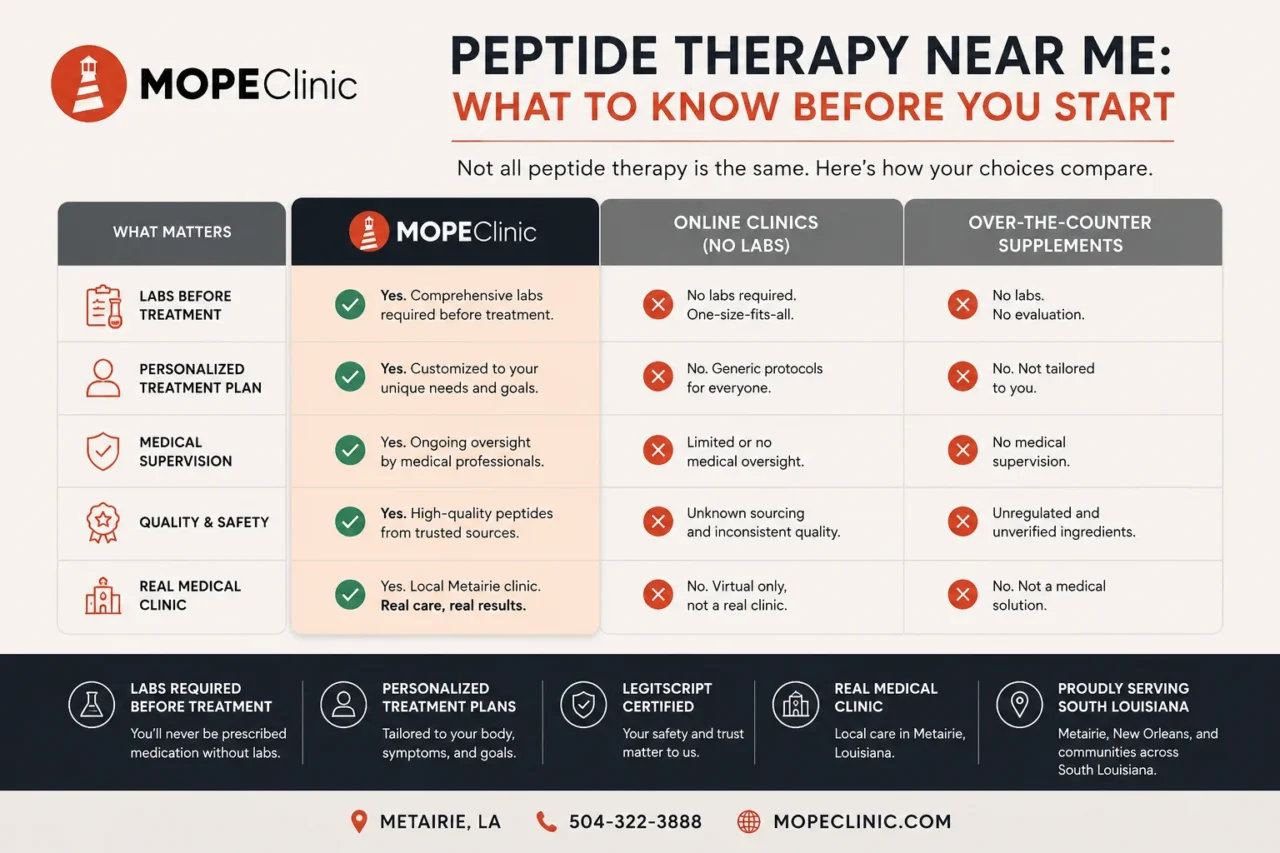
If you’ve been searching for peptide therapy near me, you’re not alone — and you’re not late. Peptide therapy is one of the fastest-growing areas in hormone and performance medicine right now, and MOPE Clinic in Metairie serves patients across Southeast Louisiana with lab-based, LegitScript-certified peptide protocols. In February 2026, a regulatory change made several key peptides legally compoundable again under physician prescription. That’s good news. It also created a flood of new clinics, online services, and grey-market vendors all competing for your attention. Knowing the difference matters — especially when you’re talking about injectable compounds that go directly into your body.
MOPE Clinic is a real physical clinic, not a telehealth prescription mill. We require labs before we write any prescription. That’s not a formality — it’s the standard.
What Is Peptide Therapy — and Why Is Everyone Suddenly Searching for It?
Peptides are short chains of amino acids. Your body already makes them — they act as signaling molecules, telling your cells to repair tissue, release hormones, regulate inflammation, and dozens of other functions. Peptide therapy uses specific synthetic or bioidentical peptide compounds to amplify those signals in targeted ways.
First, GLP-1 peptides — semaglutide and tirzepatide — went mainstream for weight loss and metabolic health, and millions of people realized peptides were already working in their bodies as medicine. That opened the door to curiosity about other peptides. Second, in February 2026, HHS Secretary Robert F. Kennedy Jr. announced that 14 peptides previously restricted under FDA Category 2 — including BPC-157, TB-500, CJC-1295, Ipamorelin, and Sermorelin — moved back to Category 1 status, so licensed compounding pharmacies can legally prepare them again under physician prescription. Third, social media and podcasts pushed peptide content to audiences that traditional medicine never reached.
The result: 10.1 million monthly searches for peptide-related keywords in the US alone, according to a 2026 keyword analysis by The Peptide Effect. “Cost of peptide therapy” searches increased over 300% year-over-year. People aren’t just curious — they’re ready to act.
The problem is that a lot of what they find isn’t clinical. It’s marketing.
Which Peptides Does MOPE Clinic Actually Use?
MOPE Clinic doesn’t offer every peptide that trends on Reddit. The protocols Chris Rue, APRN, FNP-C uses are built around compounds with the strongest clinical rationale and the clearest path to compounding pharmacy access. Here’s what that looks like in practice.
Growth Hormone Peptides: CJC-1295 and Ipamorelin
These two are typically used together. CJC-1295 is a growth hormone-releasing hormone (GHRH) analog — it stimulates your pituitary gland to produce more growth hormone. Ipamorelin is a growth hormone secretagogue that amplifies that release. Neither floods your system with synthetic HGH. Instead, they work with your own pituitary to optimize the natural pulse pattern of growth hormone secretion.
Patients using CJC-1295 and Ipamorelin commonly report improved sleep quality, faster recovery from training, better body composition, and increased energy. Chris sees this pattern consistently — particularly in patients whose labs show suppressed IGF-1 levels despite intact pituitary function. The peptides don’t replace the signal; they sharpen it.
BPC-157: Recovery and Tissue Repair
BPC-157 stands for Body Protection Compound-157. It’s a synthetic pentadecapeptide — 15 amino acids — originally derived from a protein in human gastric juice. Preclinical research is extensive, covering tendon and ligament healing, gut repair, nerve regeneration, and cardiovascular protection. Human trial data is still limited, which is exactly why you want a clinician reviewing your case rather than ordering vials from an unregulated website.
The February 2026 reclassification restored the legal compounding pathway for BPC-157, meaning patients at MOPE Clinic can now access it through a licensed pharmacy under a physician prescription. That wasn’t possible for much of 2023–2025. The compound is still investigational — Chris will tell you that directly — but the preclinical evidence is compelling enough to include it in appropriately selected recovery protocols.
Sermorelin: A Longer-Term Growth Hormone Strategy
Sermorelin has been around since the 1990s — it’s one of the older peptides in this space. Like CJC-1295, it stimulates natural growth hormone release. Chris uses it for patients who want a more conservative entry point into peptide therapy, or those whose labs show declining GH axis function as part of normal aging. Sermorelin has a well-established safety profile and fits naturally alongside TRT protocols for men managing multiple hormonal deficiencies simultaneously.
Why Does It Matter Where You Get Peptide Therapy Near You?
This is the part most peptide articles skip. The compound matters, but so does the source, the oversight, and the accountability chain around it.
The Research Vendor Route: All Responsibility on You
When you buy peptides from a research vendor — even a reputable one — you take on all of the clinical judgment yourself. You’re responsible for assessing whether the compound is appropriate for your health status, dosing it correctly, monitoring for side effects, and verifying the certificate of analysis. Independent testing of research-grade peptides has found products mislabeled, underdosed, or contaminated. That’s not theoretical — it’s documented.
The Clinical Route: Shared Accountability
When you work with a clinic, that chain looks different. A licensed provider reviews your health history and current labs. A compounding pharmacy with quality controls prepares the compound. A follow-up protocol tracks your response. If something changes, there’s a clinician to call.
Why MOPE Clinic’s Credentials Matter
MOPE Clinic adds another layer: LegitScript certification. LegitScript is a third-party verification organization that audits healthcare providers for medical, legal, and safety compliance. Most hormone clinics don’t have it. MOPE Clinic does — and that matters when you’re evaluating whether a provider is operating inside the lines.
For Southeast Louisiana patients in Metairie, New Orleans, Covington, Slidell, Mandeville, or anywhere in the region, having a physical clinic is also just practical. The first visit for any controlled substance — and some peptides fall into that category — must happen in person. A virtual-only service cannot legally fulfill that requirement.
What Should You Expect at Your First Peptide Therapy Appointment?
The process at MOPE Clinic is the same regardless of which peptide protocol you’re considering: labs first, prescription second, never the other way around.
Before Your Appointment: Prepare Your Goals and History
Before your first appointment, have a clear sense of your goals — recovery from a specific injury, improving body composition, better sleep and energy, gut healing, or some combination. Chris and his team will want to know your current medications, any prior hormone therapy, and your general health history.
During Your Appointment: Labs and Assessment
At the appointment itself, we order baseline labs. Depending on your goals, that may include IGF-1 levels, a comprehensive metabolic panel, thyroid function, and a full hormone panel. Those results determine whether peptide therapy is appropriate, which compounds fit your situation, and what starting doses make sense. We don’t write any protocol before that picture is complete.
After Your Appointment: Compounding and Follow-Up
From there, a licensed pharmacy prepares your compounded peptide medication and delivers or we coordinate pickup. Follow-up appointments track your response and allow for protocol adjustments. This isn’t a one-time prescription — it’s an ongoing clinical relationship.
MOPE Clinic’s hours accommodate working schedules: Monday through Thursday 8AM–7PM, Friday 8AM–5PM, and Saturday 8AM–4PM. The clinic is located at 4417 Lorino St #103 in Metairie, easily accessible from New Orleans, Kenner, and the surrounding parishes.
Is Peptide Therapy Right for You?
Not for everyone, and that’s worth saying plainly. Peptide therapy isn’t a shortcut and it isn’t a solution to lifestyle fundamentals. However, for patients who have already addressed sleep, nutrition, and training, and whose labs point to specific deficiencies or suppressed axes, peptides can meaningfully move the needle on recovery, body composition, and quality of life.
The patients who tend to do best with peptide protocols at MOPE Clinic share a few characteristics: they’ve done TRT or are evaluating it alongside peptides; they have specific, measurable goals; and they’re committed to the follow-up process. Peptides work through physiological systems that take weeks to respond, not days. Patients who want an overnight transformation usually aren’t the right fit.
If you’ve already looked into GLP-1 therapy for metabolic health, you’ve already encountered one class of peptides. The same lab-first, clinician-led approach applies across the board.
Take the 2-minute optimization quiz at mopeclinic.com if you’re not sure where to start. It’ll give you a clearer picture of which services are most relevant for your situation. Or call 504-265-5491 to book a consultation directly — that’s the fastest way to get your labs ordered and your questions answered by someone who actually knows this space.
Book your initial consultation at MOPE Clinic in Metairie. Labs are required before any prescription is written. Call 504-265-5491 or visit mopeclinic.com to get started.
Frequently Asked Questions
Is BPC-157 legal to prescribe now? As of February 2026, BPC-157 moved from FDA Category 2 back to Category 1, which restores the legal pathway for licensed 503A compounding pharmacies to prepare it under physician prescription. That means a provider like Chris Rue can legally prescribe it and route the prescription to a compounding pharmacy. Buying it from an unregulated research vendor is a different situation with different risks — no physician oversight, no verified purity, and no accountability if something goes wrong.
How much does peptide therapy cost? At a legitimate clinic with required labs, you’ll typically pay an initial consultation fee ($150–$400), baseline labs ($100–$250), and monthly compounded medication ($200–$500 depending on the protocol). That range reflects what a supervised clinical program actually costs. Research-vendor pricing is lower, but it doesn’t include a clinician, a pharmacy-grade compound, or a follow-up protocol. They’re not the same thing. Call 504-265-5491 for current MOPE Clinic pricing.
Do I need labs before starting peptides? Yes. At MOPE Clinic, labs are required before any prescription is written — no exceptions. That requirement exists because peptides interact with hormonal axes, and prescribing without a baseline picture of your IGF-1, hormone levels, and metabolic markers is guesswork. Labs protect you and make the protocol more effective.
Can I do a telehealth-only consultation at MOPE Clinic? Some consultations can happen via telehealth, but the first visit for controlled substances must be in person — that’s a legal requirement, not a preference. MOPE Clinic is a real physical clinic in Metairie, not a virtual-only service. If you’re in Southeast Louisiana, coming in for that first appointment is straightforward.
What peptides are used for recovery vs. performance vs. weight loss? Recovery protocols typically feature BPC-157 and TB-500, which target tissue repair, inflammation reduction, and healing acceleration. Performance and body composition protocols most commonly use CJC-1295 with Ipamorelin or Sermorelin to optimize the growth hormone axis, improving muscle recovery, sleep quality, and body composition over time. Weight loss and metabolic health fall under GLP-1 therapy — semaglutide and tirzepatide — which are a distinct class of peptides with FDA approval for specific indications. Your labs and goals determine which direction makes the most sense.
Have more questions about peptide therapy? The MOPE Clinic FAQ page covers common questions about hormones, labs, and treatment options across all of our services.